
The phrase cardiac arrest meaning in urdu is one of the most-searched medical queries among Urdu-speaking readers, and it has earned that attention honestly. News anchors use the term dramatically, TV dramas overuse it, and — here’s the twist — most Urdu dictionary websites translate it incorrectly. This guide gives you the accurate Urdu meaning, explains what actually happens inside the body, and walks through the causes, symptoms, and prevention steps, backed by real medical sources instead of guesswork.
Cardiac Arrest Meaning in Urdu (Quick Answer)
Cardiac Arrest Meaning in Urdu: Dil ka achanak dharakna band ho jana. Is ka medical matlab Bandish-e-Qalb hai. Cardiac arrest us waqt hota hai jab dil ke andar electrical system mein achanak kharabi paida ho jaye aur dil khoon pump karna band kar de.
Yeh samajhna zaroori hai ke cardiac arrest aur heart attack ek jaisi cheezen nahi hain. Cardiac arrest mein asal masla dil ki electrical activity ka hota hai, jabke heart attack mein aam tor par dil tak khoon pohanchane wali blood vessel mein blockage hoti hai.
.
In simple words, cardiac arrest means the heart suddenly stops working properly, cutting off blood flow to the brain and every other organ. It is not the same thing as a “heart attack,” even though the two get mixed up constantly. We’ll untangle that confusion in a moment.
Why Do Urdu Dictionaries Get This Word Wrong?
Search “cardiac arrest meaning in urdu” on most dictionary websites, and you’ll find the same wrong answer everywhere: the exact Urdu term that actually means “heart attack.” This is one of the most common medical translation mix-ups in Urdu, and it explains why so many people, even educated ones, use the two terms interchangeably.
The more accurate translation leans toward “the heart suddenly stopping” rather than an “attack” or a blockage. This single word matters more than it sounds, because heart attack and cardiac arrest need two completely different emergency responses.
What Is Cardiac Arrest?
The word “cardiac” simply means “related to the heart.” “Cardiac activity” refers to the heart’s normal electrical and pumping rhythm — the beat that moves blood every second of every day without you ever thinking about it.
Cardiac arrest happens when that electrical system misfires. Instead of a steady rhythm, the signals turn chaotic, and the heart either stops beating altogether or quivers uselessly instead of pumping, according to Cleveland Clinic. Blood stops moving. Oxygen stops reaching the brain and organs. Within seconds, the person collapses and loses consciousness.
This is very different from a heart weakening gradually over years. Cardiac arrest is abrupt — one moment someone is fine, the next moment they have no pulse and aren’t breathing. That suddenness is exactly why it needs emergency treatment within minutes, not hours.
Cardiac Arrest vs Heart Attack — What’s the Real Difference?
People use “heart attack” and “cardiac arrest” as if they’re the same thing, but doctors don’t, because the two problems work almost like opposites.
A heart attack is a plumbing problem. A blocked artery cuts off blood supply to part of the heart muscle, and that section of tissue starts to get damaged. The heart usually keeps beating throughout, sometimes irregularly, and the person often stays conscious, at least at first.
Cardiac arrest is an electrical problem. The heart’s rhythm goes haywire, pumping stops almost instantly, and the person loses consciousness within seconds, not minutes.
| Heart Attack | Cardiac Arrest | |
|---|---|---|
| Root cause | Blocked artery (circulation problem) | Faulty electrical signal |
| Heartbeat | Usually continues, may be irregular | Stops completely |
| Onset | Symptoms often build over minutes to hours | Collapse happens within seconds, often with no warning |
| Consciousness | Person is usually still conscious | Person loses consciousness almost immediately |
A heart attack can trigger a cardiac arrest, but they are not the same event — and neither is the Urdu meaning behind them.
Cardiopulmonary Arrest and CPR — What Do These Terms Mean?
“Cardiopulmonary arrest” is really just a more complete medical term for the same event. It means both the heart (cardiac) and breathing (pulmonary) have stopped, since one usually follows the other within moments once cardiac arrest begins.
This is where CPR fits in. Cardiopulmonary resuscitation (CPR) is the emergency technique used to manually keep blood and oxygen moving once the heart has stopped. CPR helps maintain blood flow to the brain and other vital organs until an AED can be used or professional medical help arrives.
CPR does not “cure” cardiac arrest on its own. It buys time. And that time, even a few extra minutes, can be the difference between survival and permanent brain injury.
Symptoms of Cardiac Arrest — What to Watch For
Sudden cardiac arrest often occurs without warning, although some people may experience symptoms such as chest discomfort, shortness of breath, palpitations or dizziness beforehand. In other cases, a few brief signs appear seconds to minutes before collapse:
- Sudden chest pain or pressure
- Shortness of breath
- Nausea or vomiting
- Heart palpitations (a racing or fluttering feeling)
- Sudden dizziness or lightheadedness
- Unexplained sudden weakness
- Gasping or abnormal, irregular breathing
Once cardiac arrest actually begins, the signs are unmistakable: the person is unresponsive, has no pulse, and is not breathing normally. This is quite different from typical heart attack symptoms, which usually build gradually over minutes or hours — cardiac arrest symptoms, when they exist at all, disappear into collapse within seconds.
A Case That Shows Why a Normal ECG Does Not Always Rule Out a Heart Attack
Here’s a real example that shows exactly why cardiac arrest and heart attack can be so hard to catch in the moment — even for trained staff.
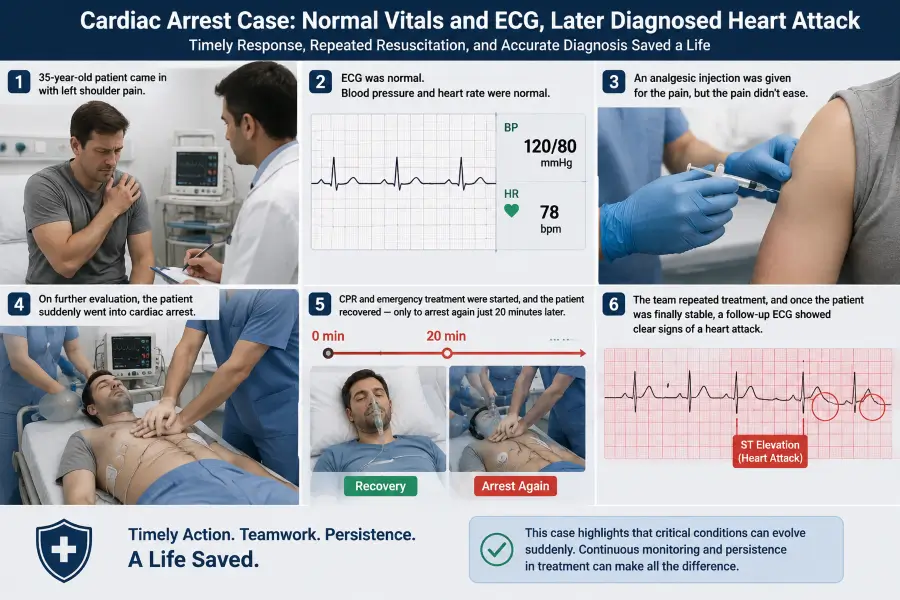
A 35-year-old patient came in with left shoulder pain. The ECG was normal. Blood pressure was normal. Heart rate was normal. An analgesic injection was given for the pain, but the pain didn’t ease. On further evaluation, the patient suddenly went into cardiac arrest. CPR and emergency treatment were started, and the patient recovered — only to arrest again just 20 minutes later. The team repeated treatment, and once the patient was finally stable, a follow-up ECG showed clear signs of a heart attack.
Doctor’s Case Discussion: The real-life case discussed in this section was shared by a doctor. For the complete case and medical discussion, watch the original video here: [Watch the Original Video]
Why Did This Happen?
Left shoulder pain was the real warning sign. The heart and the shoulder share overlapping nerve pathways, so pain from an oxygen-starved heart muscle can show up as shoulder pain instead of classic chest pain. This is called referred pain, and it’s a well-documented, if often missed, way that a heart attack introduces itself — age 35 does not rule it out.
The first ECG being normal didn’t rule out a heart attack. A single ECG only catches a heart attack in a minority of cases when taken very early. The classic warning signs on an ECG, like ST elevation, develop and become clearer over minutes to hours as the damage progresses — not necessarily in the first few minutes. This is exactly why repeat ECGs are standard practice whenever symptoms continue.
The pain not responding to a pain-relief injection was itself a red flag. An analgesic can quiet the pain signal, but it does nothing for a blocked artery. Real cardiac pain typically keeps coming back until blood flow is actually restored — unlike muscle or joint pain, which usually settles down with a painkiller and rest.
The cardiac arrest happened because the heart turned electrically unstable. As the heart muscle kept losing oxygen, the tissue around the blockage became irritable enough to throw the heart into a chaotic rhythm — almost always ventricular fibrillation. That chaotic rhythm, not the blockage itself, is what actually causes the sudden collapse.
The second arrest, 20 minutes later, is the most important lesson here. CPR and the shocks delivered during resuscitation restart the heart’s rhythm, but they don’t unblock the artery. As long as that blockage stays in place, the surrounding heart muscle remains starved of oxygen and electrically unstable — so the same trigger can cause another arrest. This pattern, doctors sometimes call it recurrent or refractory ventricular fibrillation, is well documented in cases where the underlying blocked vessel hasn’t been treated yet.
The heart attack only became obvious on the follow-up ECG because that’s simply how heart attacks behave on paper — the tell-tale changes build up over time. The first ECG was not wrong; it was just early.
The takeaway: a normal ECG and normal vitals at first contact do not rule out a heart attack — especially when pain continues despite treatment. This is exactly why doctors are trained to keep watching, repeat the ECG, and take unexplained shoulder pain seriously instead of dismissing it as muscular.
What Causes Cardiac Arrest?
Coronary artery disease — narrowed or blocked heart arteries — is the most common underlying cause of cardiac arrest in adults. Several other conditions can trigger the same electrical failure:
- Abnormal heart rhythms (arrhythmias), especially a chaotic rhythm called ventricular fibrillation
- A previous heart attack that has damaged heart tissue
- Heart failure or a thickened, enlarged heart muscle
- Heart problems present since birth
- Severe blood loss or major physical trauma
- Serious infections affecting the heart
- Severe breathing failure that starves the heart of oxygen
- Drug overdose or a dangerous buildup of certain medicines
People already living with heart disease are sometimes called a “cardiac patient” or “heart patient.” These aren’t separate medical terms — just everyday phrases for someone under treatment or monitoring for a heart condition. Being a cardiac patient does raise the statistical risk of cardiac arrest, but plenty of cases happen in people with no known heart disease at all, including young, apparently healthy individuals.
Cardiac Death vs Cardiac Arrest — Is There a Difference?
“Cardiac death” and “sudden cardiac death” describe what happens when cardiac arrest goes untreated. Cardiac arrest is the event — the heart stopping. Cardiac death is the outcome, if nobody intervenes with CPR or a defibrillator in time.
This distinction matters, because cardiac arrest on its own is not automatically fatal. With CPR started immediately and a defibrillator shock delivered quickly, many people survive and recover. Without that rapid response, cardiac arrest turns into cardiac death within minutes.
Can Cardiac Arrest Be Prevented?
You cannot eliminate the risk completely, but you can lower it significantly with the same habits that protect overall heart health:
- Manage high blood pressure, high cholesterol, and diabetes with regular check-ups
- Avoid smoking and recreational stimulant drugs, and discuss other cardiovascular risk factors with a healthcare professional.
- Stay physically active most days of the week
- Maintain a healthy body weight
- Eat a heart-friendly diet, low in processed food and excess salt
- Get screened for sleep apnea, which puts extra strain on the heart
- Ask a doctor about genetic screening if cardiac arrest, sudden death, or unexplained fainting runs in the family
None of these steps come with a 100% guarantee — cardiac arrest can still happen to people who do everything “right.” But consistently lowering cardiovascular risk factors remains the single most effective, evidence-based prevention strategy available today.
What to Do If Someone Has Cardiac Arrest
You don’t need a medical degree to help in this situation — you mainly need to not freeze.
- Call for emergency medical help immediately. Every second without treatment lowers the chances of survival.
- Start CPR right away, even hands-only chest compressions if you’re not trained in rescue breaths. Doing something imperfectly beats doing nothing perfectly.
- Use an AED (automated external defibrillator) if one is available nearby — most devices talk you through every step out loud.
- Keep going until professional help arrives or the person shows clear signs of recovery.
Brain and other vital organs can suffer serious damage when blood flow is interrupted, which is why CPR and defibrillation should begin as quickly as possible. That short window is exactly why bystander action, often from someone with zero medical training, ends up saving more lives than waiting for an ambulance to arrive.
Frequently Asked Questions
What does cardiac arrest mean in English, simply put? It means the heart has suddenly and unexpectedly stopped pumping blood, usually because of an electrical malfunction rather than a blockage.
Is “cardiac attack” the same as cardiac arrest? “Cardiac attack” isn’t an official medical term. People who use this phrase usually mean either “heart attack” or “cardiac arrest” — the two distinct conditions explained above.
What is cardiopulmonary arrest in simple words? It’s essentially the same event as cardiac arrest, described more completely — the heart and breathing stop together.
Does every heart patient eventually experience cardiac arrest? No. Heart disease raises the statistical risk, but most cardiac patients never experience cardiac arrest, especially with proper treatment and regular monitoring.
Can a young, healthy person get cardiac arrest? Yes. It’s more common in older adults with underlying heart disease, but cardiac arrest can affect people of any age, including children and teens, sometimes with no prior heart condition at all.
Medical Disclaimer
This article is for general educational purposes only and does not replace professional medical advice, diagnosis, or treatment. If you or someone near you shows signs of cardiac arrest, call your local emergency number immediately instead of relying on this or any other online article.
Summary
Cardiac arrest simply means the heart has suddenly stopped beating because of an electrical fault, not a blockage. Most Urdu dictionaries mistranslate the term as “heart attack,” but the two conditions are medically different and require different emergency responses.
A heart attack happens when a blocked artery slowly damages the heart muscle. Cardiac arrest happens when the heart’s electrical system fails all at once, causing the person to lose consciousness within seconds.
Warning signs of cardiac arrest include chest pain, shortness of breath, a racing or irregular heartbeat, and sudden weakness — though in many cases, there is no warning at all.
If someone collapses from cardiac arrest, call for emergency help immediately, start CPR without delay, and use an AED if one is available nearby. Every minute that passes without treatment lowers the chances of survival.
The best way to lower the risk of cardiac arrest is to keep blood pressure, cholesterol, and diabetes under control, avoid smoking, and go for regular health check-ups.
This article is for general information only. In any medical emergency, contact a doctor or hospital immediately.
Looking for information about a specific medicine? Explore our [Medicine Information] section for details about medicines, including their uses, side effects, dosage, and precautions.
this information is usefull