
Last updated: 26 October 2026
Quick Answer: Montika Sachet 4mg is a children’s medicine containing montelukast.
- Uses: Helps prevent asthma symptoms and manage allergic rhinitis.
- Dosage: Each sachet contains 4mg; the doctor determines the appropriate dose and duration.
- How to use: Usually taken daily as prescribed.
- Important: It does not treat a sudden asthma attack.
- Side effects: Mood or behavior changes may occur. Contact a healthcare professional if unusual symptoms develop.
What is Montika sachet?
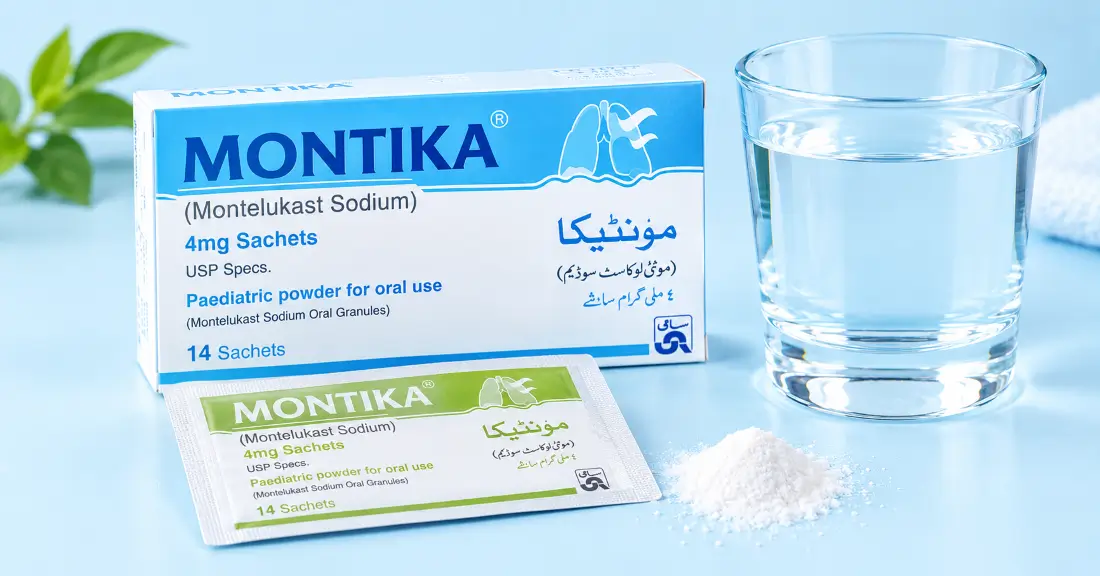
Montika sachet contains montelukast sodium, 4 mg per sachet, as granules. Montelukast belongs to a group called leukotriene receptor antagonists. It blocks leukotrienes, chemicals in the body that cause airway swelling and allergy symptoms.
Pharmacy listings in Pakistan show Montika as a product of Sami Pharmaceuticals. Montika also comes as 4 mg and 5 mg chewable tablets and as a 10 mg tablet. The sachet is the form made for the youngest children, who cannot chew a tablet.
What is Montika sachet used for?
Doctors use montelukast granules for two main problems:
- Asthma: it helps prevent wheezing, cough and breathing trouble caused by asthma.
- Allergic rhinitis: it can ease sneezing, a blocked nose and a runny nose when other medicines are not suitable.
Montelukast is not a reliever. Do not use it for a sudden asthma attack. The doctor prescribes a separate reliever inhaler for attacks.
Which age group can take it?
Labels for montelukast 4 mg granules cover young children, but the exact age limits differ by country and by condition. The UK product information covers children from 6 months to 5 years. It says the granules are not recommended below 6 months. The US label lists asthma use from 12 months and year-round (perennial) allergic rhinitis use from 6 months.
Because of these differences, the child’s doctor should confirm the age and the reason for use. Never give a sachet to a baby on someone else’s advice.
How to give Montika sachet
Montelukast granules are given by mouth. The label gives a few safe ways:
- Keep the sachet closed until the moment you give it.
- Pour the whole sachet straight into your child’s mouth, or onto a clean spoon.
- Or mix the whole sachet into one teaspoon (5 mL) of cold or room-temperature soft food. Applesauce, mashed carrot, rice, ice cream, baby formula and breast milk are listed.
- Give the full dose within 15 minutes of opening the sachet.
- Do not store a mixture for later.
Do not dissolve the granules in a bottle or glass of liquid. Your child may drink liquid right after swallowing the granules. The granules can be given with or without food.
How often is it given?
The 4 mg sachet is a single fixed dose. For asthma, montelukast is taken once a day in the evening. For allergic rhinitis, it can be taken at any time of day, at about the same time each day.
Give the sachet exactly as the doctor prescribed. Do not split a sachet, give two sachets, or give it more often than prescribed. Your child’s doctor chooses the plan, because the right age group and form depend on the child.
Tell the doctor before starting
Tell the doctor or pharmacist if your child:
- has had a mental health or behaviour problem, or sleeping problems
- has liver disease
- is allergic to montelukast or any ingredient in the sachet
- takes other medicines, especially gemfibrozil, phenobarbital or rifampin
Do not stop other asthma medicines, such as inhalers, when montelukast starts. Montelukast should not suddenly replace an inhaled or oral steroid.
Side effects of Montika sachet
Common side effects are usually mild. They include headache, stomach pain, diarrhoea, tiredness and heartburn. In children, ear pain and fever have also been reported.
Tell the doctor if a mild side effect is severe or does not go away.
When to stop and call the doctor
Montelukast can cause serious mental health and behaviour changes. In 2020 the US FDA added a Boxed Warning, its strongest warning, to montelukast for this reason. These effects can happen even in children with no earlier mental health problem. They may also appear after the medicine is stopped.
Call the doctor right away if your child shows any of these:
- unusual aggression, agitation or irritability
- new anxiety, low mood or unusual sadness
- trouble sleeping, nightmares or sleepwalking
- hallucinations, confusion or restlessness
- thoughts of self-harm, in children old enough to talk about them
Tell the doctor first about these changes. Parents and caregivers should know these signs, because a young child cannot always describe them.
Also get urgent medical help for signs of a serious allergic reaction. These are swelling of the face, lips or tongue, hives, a spreading rash, or trouble breathing or swallowing. If your child has severe breathing trouble, go to emergency care immediately.
What if a dose is missed?
Skip the missed dose and go back to the normal schedule. Do not give a double dose to make up for it. Do not give more than one dose in 24 hours.
How to store Montika sachet
Keep the sachets in their original pack at room temperature, away from light, heat and moisture. Keep them out of the reach of children. Do not use a sachet that is torn or open.
Montika sachet price in Pakistan
Pharmacy listings checked in October 2026 show about PKR 430 for a pack of 14 sachets (4 mg). Prices change by pharmacy, city and batch, so check the pack and ask your pharmacist for the current price.
Montika is a prescription medicine in Pakistan according to pharmacy listings, so buy it against the doctor’s prescription.
Montika sachet and chewable tablet: what is the difference?
| Form | Strength | Usually used for |
|---|---|---|
| Sachet (granules) | 4 mg | Young children who cannot chew tablets |
| Chewable tablet | 4 mg, 5 mg | Older children, as the doctor decides |
| Tablet | 10 mg | Adults and teenagers |
The strength matters. Never swap one form for another without asking the doctor.
Related Medicine Information for Cough
Montika Sachet 4mg is used to help manage asthma symptoms and allergic rhinitis in children, while cough medicines may be used for different types of cough. Learn more about Acefyl Cough Syrup uses, dosage and side effects and Hydryllin Syrup uses and precautions. These medicines have different ingredients and uses, so children should receive them only according to a healthcare professional’s advice.
Frequently asked questions
Can I give Montika sachet to my baby?
Only if the doctor prescribes it. The UK label does not recommend montelukast granules under 6 months of age, and age limits differ for each condition.
Is Montika sachet an antibiotic or a steroid?
No. It is neither. It blocks leukotrienes and is used to control asthma, chest congestion and allergy symptoms.
Can I mix Montika sachet in milk?
The label allows one teaspoon of baby formula or breast milk. Do not dissolve the granules in a bottle or glass of liquid. Use the mixture within 15 minutes.
Does Montika sachet make a child sleepy?
Tiredness is a reported side effect. Sleep problems and nightmares are also reported, so tell the doctor about any sleep change.
How long does Montika sachet take to work?
Montelukast is a daily controller medicine, not a quick reliever. Ask the doctor how long to wait before judging the effect, and do not stop it on your own.
Can I give Montika sachet for a cold or cough?
It is not a cough or cold medicine. Use it only for the condition the doctor prescribed it for.
Is there Montika syrup?
Pharmacy listings show Montika sachets, chewable tablets and tablets, but no syrup. Ask your pharmacist if you were given a different brand.
Can my child stop Montika when symptoms go away?
Do not stop it without asking the doctor. It controls symptoms but does not cure asthma or allergies.
Disclaimer
This article is for general information only. It is not medical advice and does not replace a doctor’s advice. Always give medicine to a child exactly as the doctor or the pack label says, and ask your doctor or pharmacist if you are unsure.
References
- MedlinePlus, Montelukast: https://medlineplus.gov/druginfo/meds/a600014.html
- FDA Drug Safety Communication, montelukast Boxed Warning (4 March 2020): https://www.fda.gov/drugs/drug-safety-and-availability/fda-requires-boxed-warning-about-serious-mental-health-side-effects-asthma-and-allergy-drug
- UK product information, Montelukast 4 mg granules in sachet (emc): https://www.medicines.org.uk/emc/product/100604/smpc/print
- US prescribing information, montelukast oral granules (Drugs.com): https://drugs.com/pro/montelukast-oral-granules.html