
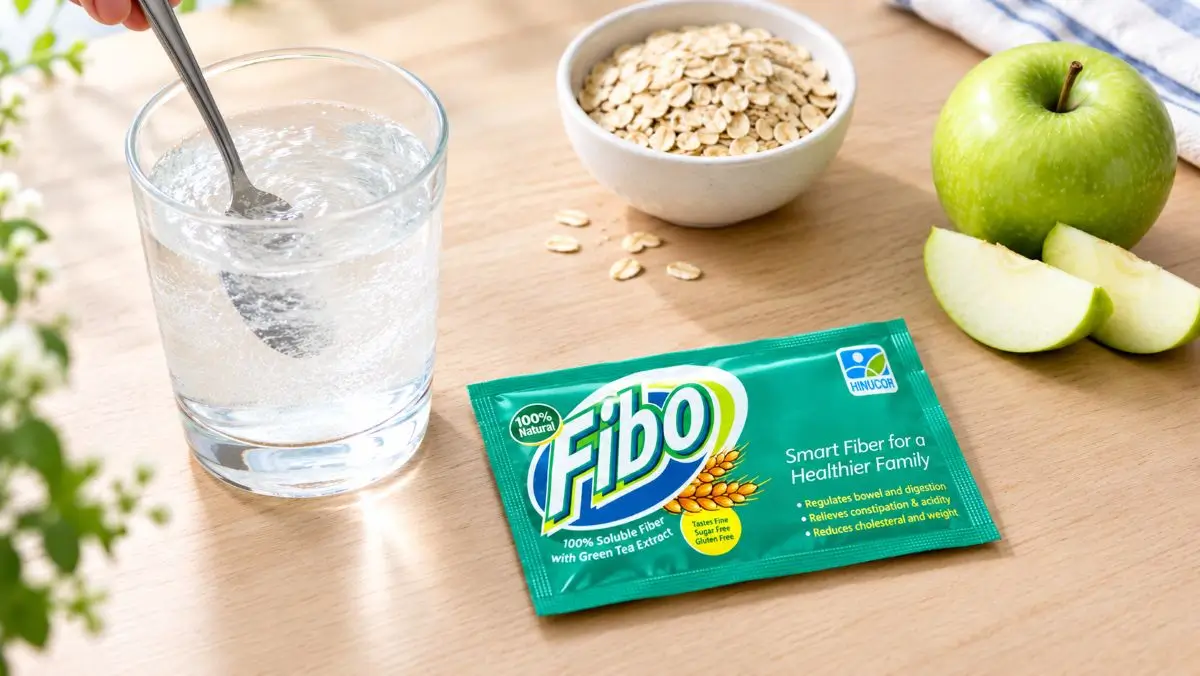
Fibo sachet is a soluble fiber supplement made with wheat dextrin and green tea extract. People in Pakistan mostly use it to ease constipation, keep bowel movements regular and support digestion. Fibo syrup is the liquid version, built around the same wheat dextrin fiber.
Fibo sachet گندم کے ڈیکسٹرن اور سبز چائے کے عرق کے ساتھ تیار کردہ ایک حل پذیر فائبر سپلیمنٹ ہے۔ پاکستان میں لوگ زیادہ تر اسے قبض کو کم کرنے، آنتوں کی حرکت کو باقاعدگی سے رکھنے اور ہاضمے کو سہارا دینے کے لیے استعمال کرتے ہیں۔ فبو سیرپ مائع ورژن ہے، جو گندم کے اسی ڈیکسٹرین فائبر کے ارد گرد بنایا گیا ہے۔
Fibo at a glance
- Main ingredient: wheat dextrin (soluble fiber)
- Extra ingredient in the sachet: green tea extract
- Brand listed by most Pakistani pharmacies: Hinucon
- Forms: sachet (powder) and syrup
- Common use: constipation, irregular bowels, low fiber intake
- Price range in Pakistan (October 2026): roughly Rs. 430 to Rs. 530, depending on the form and pharmacy
What is Fibo?
Fibo is a fiber supplement. It does not work like a strong stimulant laxative that forces the bowel to move. Instead, it adds soluble fiber to your diet and lets your gut do the work more gently.
Most Pakistani pharmacy listings name Hinucon as the maker, and a few shops sell it under the Hilton Pharma name. Check the pack in your hand, because labels and pack sizes can differ.
What is inside a Fibo sachet?
One retailer listing gives the per-sachet breakdown as 3.55 g of wheat dextrin and 15 mg of green tea extract. The powder is sugar free and dissolves in water, so it adds almost no calories.
- Wheat dextrin: a soluble fiber made from wheat starch. It dissolves easily and has very little taste or thickness.
- Green tea extract: a small amount of plant antioxidants. At 15 mg, it is a minor part of the formula, not a fat burner.
One point worth knowing: wheat dextrin comes from wheat. A pharmacy listing advises people with celiac disease or gluten sensitivity to speak to a doctor first.
Fibo sachet vs Fibo syrup: what is the difference?
Both products are built around wheat dextrin, so the idea behind them is the same. The difference is the form and, in some listings, the rules for buying them.
- Fibo sachet: a powder you stir into a glass of water or another drink. It also contains green tea extract.
- Fibo syrup: a ready-to-take liquid. Some pharmacy listings mark it as prescription-only, so ask your pharmacist or doctor which pack suits you.
If swallowing powder in a drink is a problem, or the person using it is a child or an older adult, the syrup form can feel easier. A doctor can guide that choice.
Fibo uses: what is it taken for?
1. Constipation and hard stools
This is the main reason people reach for Fibo. Soluble fiber holds water in the stool and helps it stay softer. Softer stool is easier to pass, and the gut gets into a steadier rhythm over a few days.
2. Irregular bowel movements
If your diet is low in vegetables, fruit, pulses and whole grains, your body may not get enough fiber. A supplement can fill part of that gap. A medical review of wheat dextrin concluded that soluble fiber supplements may help people whose daily fiber intake falls below the recommended level.
3. Digestive comfort
Pharmacy listings also mention relief from acidity and indigestion. Treat this as a supporting benefit, not the main job. If acidity is your real problem, a doctor should look at the cause.
4. Gut health
Wheat dextrin is fermented by gut bacteria, which makes it a prebiotic-type fiber. That is different from a probiotic, which supplies live bacteria. If you are comparing the two, our Probiotic Sachet article explains how probiotics work.
Fibo benefits: what to expect and what not to
The benefits are real but modest. Fiber supplements help many people with mild, occasional constipation, but results differ from person to person. Some researchers also point out that soluble, fermentable fibers do not act as laxatives in the same way as bulk-forming fibers, so Fibo may feel slower or gentler.
- Likely: softer stools, more regular visits to the toilet, a steadier digestive routine.
- Possible but small: a feeling of fullness after meals, and a mild effect on cholesterol when combined with a healthy diet.
- Not a promise: quick weight loss. The green tea content is tiny, so any weight benefit comes from fuller meals and better habits, not from the sachet alone.
Does Fibo sachet help with weight loss?
It can play a small supporting role. Fiber makes you feel full for longer, which may help you eat a little less. But no sachet melts fat on its own. Walking, sleep, portion control and a balanced diet do the heavy lifting.
How to take Fibo sachet
Pharmacy pages do not agree on one schedule. One listing suggests a single sachet a day for adults and for children above 6 years. Another lists one sachet a day for ages 7 to 11 and two to three sachets a day from age 12. Because of that gap, the printed label on your pack and your doctor’s advice should decide your dose.
The usual steps are simple:
- Stir the powder into a glass of water, juice or another drink until it dissolves.
- Drink it straight away, ideally before a meal.
- Drink plenty of water through the day, because fiber needs fluid to work well.
- Start with the lowest suggested amount, so your stomach has time to adjust.
Do not increase the number of sachets just because results feel slow. More fiber does not mean faster relief, and it often means more gas.
Fibo side effects
Most people tolerate Fibo well. The common effects are mild and often fade after the first few days:
- Gas and flatulence
- Bloating
- Stomach cramps or rumbling
- Nausea
- Loose stools, mainly at higher doses
Stop using it and speak to a doctor if you get severe stomach pain, repeated vomiting, or an allergic reaction such as rash, itching or swelling.
Who should be careful with Fibo?
Talk to a doctor or pharmacist first if any of these apply to you:
- You have a known allergy to wheat or any ingredient in the product.
- You have celiac disease or gluten sensitivity.
- You have, or may have, an intestinal blockage. This is a listed reason not to use wheat dextrin fiber.
- You take diabetes medicines. Soluble fiber can slow carbohydrate absorption, so blood sugar may need closer watching.
- You are pregnant or breastfeeding.
- The user is a child. Pharmacy listings mention use above 6 years, but a doctor should confirm the dose.
Also, if you take other medicines, ask your pharmacist about timing. Fiber can affect how some medicines are absorbed.
Fibo price in Pakistan
Prices change with the pharmacy, pack size and city, so treat these as a guide. In October 2026, one pharmacy listing showed Fibo sachet at Rs. 526 and Fibo syrup at Rs. 525. Another listing showed the Hilton Pharma Fibo powder sachet at Rs. 432. Always check the current price at your pharmacy or on a trusted online store before buying.
Fibo vs ispaghol: which one suits you?
Ispaghol (psyllium husk) is another common fiber in Pakistan. It is a bulk-forming fiber, while Fibo uses wheat dextrin. Ispaghol tends to be a stronger stool bulker, whereas Fibo dissolves cleanly and has almost no taste. If you have used one without good results, a doctor can help you decide whether to switch. For a stronger option, you may want to read our Movcol Sachet article.
Simple habits that make fiber work better
- Drink enough water, since fiber without fluid can make constipation worse.
- Add vegetables, fruit, oats, lentils and whole wheat roti to your meals.
- Walk for 20 to 30 minutes most days.
- Do not ignore the urge to go to the toilet.
When should you see a doctor?
A supplement is not the answer to every bowel problem. See a doctor if constipation lasts more than two to three weeks, or if you notice blood in the stool, unexplained weight loss, severe pain, black stools, or a sudden change in your usual bowel habits.
Frequently asked questions
What is Fibo sachet used for?
Fibo sachet is used to relieve constipation, keep bowel movements regular and support digestion. It is a soluble fiber supplement, not a stimulant laxative.
What is Fibo sachet made of?
It contains wheat dextrin, a soluble fiber, plus a small amount of green tea extract. One retailer lists 3.55 g of wheat dextrin and 15 mg of green tea extract per sachet.
What is the price of Fibo sachet in Pakistan?
Listings in October 2026 show about Rs. 432 to Rs. 526 per pack, and Fibo syrup at about Rs. 525. The exact price depends on the pharmacy and pack size.
Is Fibo syrup the same as Fibo sachet?
They share the same main fiber, wheat dextrin, but they are different forms. The sachet is a powder that also contains green tea extract, and the syrup is a liquid. Some pharmacy listings mark the syrup as prescription-only.
What are the side effects of Fibo?
The most common ones are gas, bloating, stomach cramps, nausea and loose stools at higher doses. They are usually mild and settle as the body adjusts.
Can Fibo sachet help with weight loss?
Only in a small, supporting way. Fiber can help you feel full, but the green tea extract is minimal, and there is no shortcut to weight loss without diet and activity changes.
How many Fibo sachets can I take in a day?
Pharmacy listings differ, from one sachet a day to a few for older children and adults. Follow the label on your pack or your doctor’s advice instead of guessing.
Is Fibo safe for children?
Pharmacy listings mention use from about 6 or 7 years of age, with a lower dose for younger children. Ask a doctor before giving it to a child.
Can people with diabetes use Fibo?
Soluble fiber can slow how fast carbohydrates are absorbed, which may affect blood sugar. People on diabetes medicines should check with their doctor first.
Medical disclaimer
This article is for general information only and does not replace advice from a doctor or pharmacist. Do not start, stop or change any medicine or supplement without professional guidance, especially for children, pregnant women and people with long-term illnesses.
Sources
- Fibo Sachet, Oladoc
- Fibo Syrup, Oladoc
- Fibo Sugar Free Sachet, MyVitaminStore
- Fibo Powder Sachets, Healthwire
- Soluble fibers and wheat dextrin: a review, Journal of International Medical Research
- Constipation, NHS
- Dietary fiber, MedlinePlus