
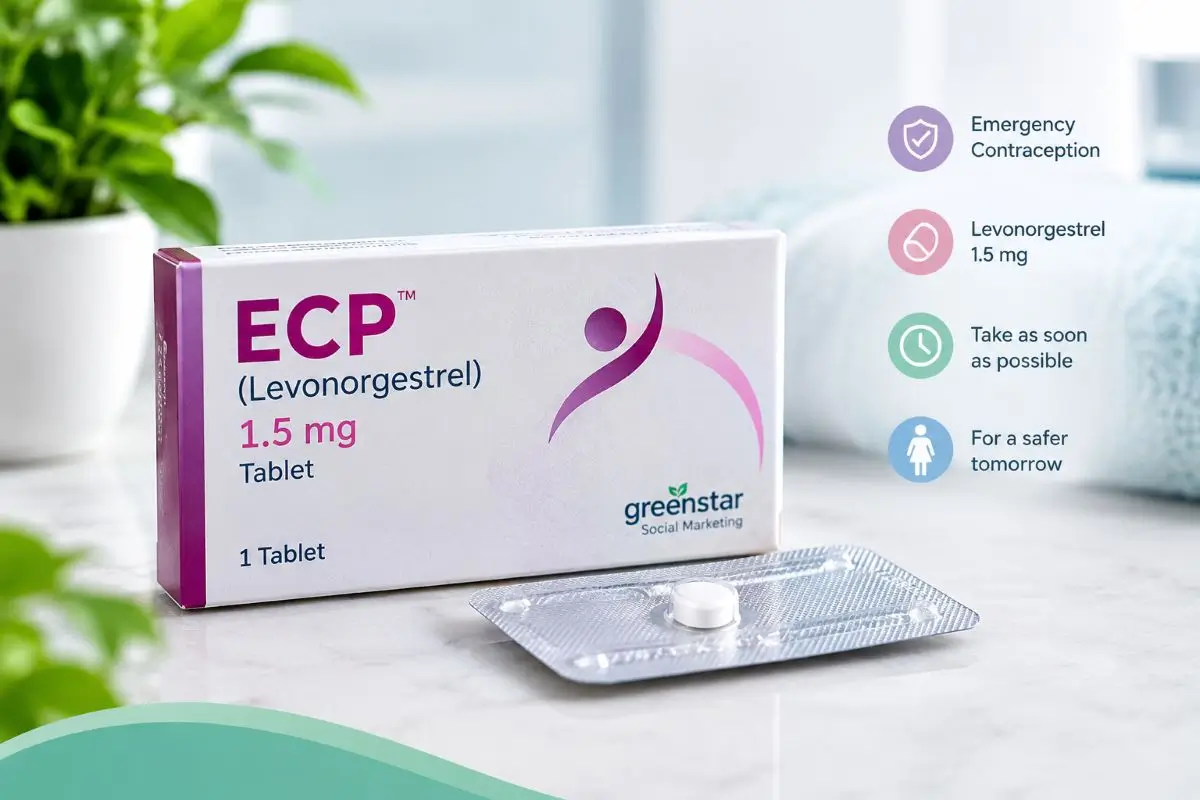
ECP Tablet
ECP (Emergency Contraceptive Pill) is used to help prevent pregnancy after unprotected sexual intercourse or contraceptive failure.
- Active ingredient: Levonorgestrel
- Common strength: 0.75mg (2 tablet blister) or 1.5 mg (single tablet)
- ECP tablet dosage: Usually one 1.5 mg tablet
- When to take: As soon as possible, preferably within 72 hours
- Can it work after 72 hours? Emergency contraception may still be possible up to 120 hours (5 days), but effectiveness decreases with time. Seek prompt professional advice about the best option.
- Common side effects: Nausea, headache, tiredness, cramps and changes in the next period
- Is ECP an abortion pill? No. It does not terminate an established pregnancy.
- Does it protect against future intercourse? No. It is for emergency use only.
Important: ECP is not 100% effective and does not protect against sexually transmitted infections. If your period is late or pregnancy is suspected, take a pregnancy test and seek medical advice.
What Is an ECP Tablet?
An ECP tablet is an emergency contraceptive pill used to help prevent pregnancy after unprotected sexual intercourse or when regular contraception has failed.
ECP stands for Emergency Contraceptive Pill. In Pakistan, the ECP product marketed by Greenstar Social Marketing contains levonorgestrel 1.5 mg in a single tablet. Other emergency contraceptive products may contain levonorgestrel in different strengths, so it is important to check the medicine label before use.
Emergency contraception may be considered after situations such as:
- A condom breaking or slipping off
- Unprotected sexual intercourse
- Missing contraceptive pills or using them incorrectly
- A contraceptive method failing
- Sexual intercourse without a reliable contraceptive method
ECP is intended for emergencies. It is not designed to replace regular contraception, and it does not protect against sexually transmitted infections (STIs).
Important: Emergency contraceptive pills work best when taken as soon as possible after unprotected intercourse. If you need emergency contraception, do not delay seeking advice from a pharmacist or healthcare professional.
ECP Tablet Uses
The main ECP tablet use is to reduce the chance of pregnancy after unprotected sex or contraceptive failure.
1. After Unprotected Sexual Intercourse
ECP may help prevent pregnancy if a person has had unprotected sexual intercourse and does not want to become pregnant.
The sooner levonorgestrel is taken, the better the chance of preventing pregnancy.
2. After Condom Failure
A condom may break, slip or be used incorrectly. In such situations, emergency contraception may be considered if pregnancy is a concern.
3. After Missed Contraceptive Pills
Missing or incorrectly taking regular contraceptive pills can sometimes increase the risk of pregnancy. Whether ECP is needed depends on the type of contraceptive pill, how many doses were missed and when intercourse occurred.
A pharmacist or healthcare professional can help assess the situation.
4. When Regular Contraception Has Failed
Emergency contraception may be considered after certain contraceptive failures. It is important to understand that ECP is a backup option rather than a routine contraceptive method.
The World Health Organization (WHO) explains that emergency contraception can be used after unprotected intercourse or contraceptive failure.
How Does ECP Tablet Work?
Levonorgestrel is a progestogen hormone. When used as emergency contraception, it mainly works by preventing or delaying ovulation, which is the release of an egg from the ovary.
If ovulation is delayed, sperm may no longer be able to fertilize an egg during that cycle.
ECP does not terminate an established pregnancy. It is not an abortion pill and should not be used to end an existing pregnancy.
The US Food and Drug Administration (FDA) describes levonorgestrel emergency contraception as a medicine that helps prevent pregnancy after unprotected sex or contraceptive failure.
ECP Tablet Dosage
The correct ECP tablet dosage depends on the active ingredient and strength printed on the product packaging.
For a product containing levonorgestrel 1.5 mg, the usual emergency contraception regimen is:
- Dose: One 1.5 mg tablet
- Timing: Take as soon as possible after unprotected intercourse
- Preferred window: Within the first 72 hours (3 days)
WHO guidance also recognizes levonorgestrel emergency contraception up to 120 hours (5 days) after intercourse, although effectiveness decreases with time. If more than 72 hours have passed, seek prompt advice from a pharmacist or healthcare professional about the most appropriate emergency contraception option.
Some products contain two 0.75 mg tablets instead of one 1.5 mg tablet. Follow the instructions for the exact product you have. Do not assume that every ECP pack has the same dosing instructions.
Do not take extra tablets or repeat the dose on your own. If vomiting occurs shortly after taking ECP, contact a pharmacist or healthcare professional because another dose may be needed.
WHO lists levonorgestrel 1.5 mg as a single-dose emergency contraception option. WHO dosage guidance
ECP Tablets: How to Use
People often search for ECP tablets how to use because emergency contraception is time-sensitive.
For a levonorgestrel 1.5 mg product, the general steps are:
- Check the active ingredient and strength on the packaging.
- Read the product leaflet or label.
- Take the prescribed or labeled dose as soon as possible after unprotected intercourse.
- If vomiting occurs within 2 hours, contact a pharmacist or healthcare professional to ask whether the dose needs to be repeated.
- Continue using contraception if you do not want to become pregnant in the future.
- Take a pregnancy test if your period is late or pregnancy is suspected.
ECP does not provide ongoing protection against pregnancy from sexual intercourse that occurs after taking the tablet. Use condoms or another suitable contraceptive method for subsequent intercourse.
ECP Tablets How to Use in Urdu
ECP tablet ko ghair-mehfooz sexual intercourse ya contraceptive failure ke baad pregnancy ka chance kam karne ke liye use kiya jata hai.
Agar product mein levonorgestrel 1.5 mg ho, to aam tor par ek tablet jald az jald leni hoti hai. Behtar effectiveness ke liye ise pehle 72 hours ke andar lena chahiye. 72 hours se zyada guzar chukay hon to pharmacist ya healthcare professional se foran mashwara karein, kyun ke emergency contraception ke doosray options bhi ho sakte hain.
ECP abortion pill nahi hai. Yeh pehle se maujood pregnancy ko khatam nahi karti aur future intercourse se pregnancy ka protection bhi nahi deti.
ECP Tablet Side Effects
ECP tablet side effects are usually mild and temporary. Not everyone experiences side effects.
Possible side effects include:
- Nausea or feeling sick
- Headache
- Tiredness or fatigue
- Dizziness
- Lower abdominal discomfort
- Period-like cramps
- Changes in the timing of the next period
- Light spotting or irregular bleeding
The next menstrual period may arrive earlier or later than expected. Bleeding after taking ECP does not always mean that pregnancy has been prevented.
The NHS notes that common side effects include headache, nausea and period-like pain or cramping. Serious side effects are rare.
ECP Tablets Side Effects in Urdu
ECP tablet lene ke baad kuch logon ko matli, sar dard, thakan, chakkar, pait ke nichlay hissay mein dard ya periods ke waqt tabdeeli mehsoos ho sakti hai.
Agle periods jaldi ya der se aa sakte hain. Halki spotting bhi ho sakti hai. Agar severe pait dard, bohat zyada bleeding, behoshi ya pregnancy ki alamat hon, to medical advice lein.
Does ECP Tablet Affect Future Fertility?
There is no evidence that levonorgestrel emergency contraception causes permanent infertility.
ECP is used for emergency pregnancy prevention. Fertility can return quickly after taking it, so a person may become pregnant after subsequent unprotected intercourse.
WHO states that emergency contraceptive pills do not harm future fertility and there is no delay in the return of fertility after their use.
If pregnancy is not desired, consider an appropriate regular contraceptive method rather than relying on ECP repeatedly.
Is ECP Tablet an Abortion Pill?
No. ECP is not an abortion pill.
Levonorgestrel emergency contraception mainly works by preventing or delaying ovulation. It does not end an established pregnancy.
If a person is already pregnant, ECP will not terminate that pregnancy. If pregnancy is suspected, a pregnancy test and appropriate medical advice are recommended.
The Punjab Population Welfare Department explains that ECPs do not work if a woman is already pregnant.
When Should You Take a Pregnancy Test After ECP?
ECP is not 100% effective. A pregnancy test may be needed if:
- Your period is more than 7 days late
- Your next period is unusually light or different from normal
- You have symptoms of pregnancy
- You are unsure whether ECP worked
A practical approach is to take a home pregnancy test 3 weeks after the unprotected intercourse if you are uncertain about the result or your period has not arrived.
If you develop severe or persistent lower abdominal pain, seek medical assessment promptly. Severe pain can have causes that need urgent evaluation.
The NHS pregnancy test guidance explains that pregnancy tests are generally reliable when used according to their instructions, but testing too early can produce an unreliable negative result.
ECP Tablet Price in Pakistan
The ECP tablet price in Pakistan can vary according to the brand, strength, pack size, manufacturer and pharmacy.
For example, Pakistan has products containing levonorgestrel 0.75 mg in two-tablet packs and levonorgestrel 1.5 mg in single-tablet packs.
The price of one product should not automatically be compared with another if the strength or pack size is different.
| Product example | Strength / pack | Price information |
|---|---|---|
| ECP (Greenstar) | Levonorgestrel 1.5 mg, 1 tablet | Check current pharmacy price |
| ECP 0.75 mg | Levonorgestrel 0.75 mg pack | Price varies by pack and retailer |
| Emkit | Levonorgestrel 0.75 mg or 1.5 mg, depending on product | Check exact product label |
| Postinor | Levonorgestrel 0.75 mg, depending on pack | Price varies by retailer |
Greenstar’s official product page lists ECP as levonorgestrel 1.5 mg in a one-tablet pack. Greenstar ECP product information
Price note: Online medicine prices may be outdated or may reflect a different pack size. Confirm the current price, strength and product details with a licensed pharmacy before purchase.
ECP Tablet in Pakistan: Available Products
The name “ECP” is used for emergency contraceptive products, but the active ingredient and strength should always be checked.
In Pakistan, levonorgestrel emergency contraception is available under different product names and strengths. The product leaflet should explain the dose and timing.
Do not select a product only by its name or price. Confirm that it is an emergency contraceptive product and check whether it contains levonorgestrel 1.5 mg or 0.75 mg tablets.
For verified product information, Greenstar lists its ECP product as levonorgestrel 1.5 mg. Official Greenstar listing
Can ECP Be Used as a Regular Contraceptive Method?
ECP is intended for emergency use, not as a regular method of contraception.
Repeated use may cause menstrual irregularities and can be less reliable than many regular contraceptive methods. It does not protect against sexually transmitted infections.
If you need contraception regularly, discuss suitable options with a healthcare professional. Options may include condoms, regular contraceptive pills, injections, implants or an intrauterine device (IUD), depending on your health and preferences.
WHO advises that people who use ECPs repeatedly or as their main contraceptive method should receive counselling about more appropriate regular contraceptive options.
Important Precautions Before Taking ECP
Before using ECP, consider the following:
- Check the exact active ingredient and strength.
- Take it as soon as possible after unprotected intercourse.
- Do not assume it will protect against future intercourse.
- Tell a pharmacist or healthcare professional about other medicines you use.
- Seek advice if you take medicines that may reduce levonorgestrel effectiveness.
- Do not use ECP as a substitute for regular contraception.
- Take a pregnancy test if your period is late or pregnancy is suspected.
Some medicines, including certain enzyme-inducing medicines, can reduce the effectiveness of levonorgestrel. If you take regular medicines, ask a healthcare professional which emergency contraception option is appropriate.
Related Medicine Information
ECP (Emergency Contraceptive Pill) is used to reduce the chance of pregnancy after unprotected intercourse or contraceptive failure. It is different from Duphaston (dydrogesterone), a prescription hormonal medicine used for certain menstrual and progesterone-related conditions. For more information, read our guide to Duphaston tablet uses, dosage, side effects and price.
Frequently Asked Questions
What is ECP tablet used for?
ECP tablet is used as emergency contraception to help prevent pregnancy after unprotected sexual intercourse or contraceptive failure, such as a broken condom.
What is the ECP tablet dosage?
For a levonorgestrel 1.5 mg product, the usual regimen is one tablet taken as soon as possible after unprotected intercourse. Always check the instructions for the exact product.
How many hours after intercourse can ECP be taken?
Levonorgestrel works best when taken as soon as possible, preferably within 72 hours. WHO guidance recognizes use up to 120 hours (5 days), but effectiveness decreases with time. Seek prompt professional advice if more than 72 hours have passed.
Does ECP tablet cause side effects?
Possible side effects include nausea, headache, tiredness, dizziness, cramps, spotting and changes in the next period. Most side effects are temporary.
Does ECP tablet terminate pregnancy?
No. ECP is not an abortion pill. It mainly works by preventing or delaying ovulation and does not terminate an established pregnancy.
Can ECP affect future fertility?
There is no evidence that levonorgestrel emergency contraception causes permanent infertility. Fertility can return quickly after taking it.
What is the ECP tablet price in Pakistan?
The price varies according to brand, strength, pack size and pharmacy. Confirm the current price and exact product details with a licensed pharmacy.
Can ECP be used regularly?
ECP is intended for emergency use, not as a regular contraceptive method. A healthcare professional can help identify a suitable ongoing method.
What should I do if I vomit after taking ECP?
If vomiting occurs within 2 hours after taking ECP, contact a pharmacist or healthcare professional because another dose may be needed.
Does ECP protect against sexually transmitted infections?
No. ECP does not prevent sexually transmitted infections. Condoms help reduce the risk of many STIs.
Final Takeaway
ECP tablet is an emergency contraceptive pill used to reduce the chance of pregnancy after unprotected intercourse or contraceptive failure. In Pakistan, the Greenstar ECP product contains levonorgestrel 1.5 mg in a single tablet.
For levonorgestrel 1.5 mg, the usual dose is one tablet taken as soon as possible, preferably within the first 72 hours. Emergency contraception may still be considered up to 120 hours after intercourse, but effectiveness decreases with time and other options may be more suitable.
ECP is not an abortion pill, does not provide ongoing protection from future intercourse and should not replace regular contraception.
If your period is late, pregnancy is suspected or you experience severe abdominal pain, seek appropriate medical advice.
Medical Disclaimer: This article is for general educational purposes only. It does not replace individual advice from a qualified healthcare professional. Always check the product label and seek professional guidance when unsure about emergency contraception.